How to De-Embed Cables: A Practical Guide for PCB and Electronics Testing

In modern electronics design and testing, understanding how
to de-embed cables is essential for obtaining accurate measurement results.
Engineers often use network analyzers, oscilloscopes, and other testing
equipment connected through cables. However, these cables can introduce losses,
reflections, and distortions that affect the accuracy of the measurements. At
BitWise Laboratories, we help clients improve signal integrity testing by
applying effective de-embedding techniques.
What Is Cable De-Embedding?
Cable de-embedding is the process of mathematically removing
the electrical effects of a cable from measurement results. Every cable
introduces some level of attenuation, delay, and impedance variation. When
testing high-speed circuits, these cable characteristics can significantly
influence the observed performance.
By de-embedding the cable, engineers can isolate the
behavior of the device under test (DUT) and obtain a more accurate
representation of its actual performance.
Why Cable De-Embedding Is Important
Accurate measurements are critical in industries such as
telecommunications, aerospace, automotive electronics, and PCB manufacturing.
Without proper de-embedding, engineers may misinterpret test results and make
incorrect design decisions.
Key benefits include:
- Improved
signal integrity analysis
- More
accurate impedance measurements
- Better
characterization of high-speed channels
- Reduced
measurement uncertainty
- Enhanced
product reliability
At BitWise Laboratories,
cable de-embedding is frequently used during advanced PCB validation and
high-frequency testing projects.
Common Sources of Measurement Errors
Several factors can affect cable performance and introduce
errors into measurements:
Cable Losses
As signals travel through a cable, some energy is lost due
to conductor resistance and dielectric losses. These effects become more
significant at higher frequencies.
Signal Reflections
Impedance mismatches between the cable, connectors, and test
equipment can cause reflections. These reflections distort the signal and
reduce measurement accuracy.
Phase Delay
Cables introduce propagation delay, which affects timing
measurements and phase-sensitive applications.
Connector Variations
Even high-quality connectors can contribute to insertion
loss and impedance discontinuities.
Understanding these factors is the first step in learning how to de-embed cables effectively.
Methods Used for Cable De-Embedding
Several techniques are commonly used depending on the
testing environment and equipment available.
S-Parameter Characterization
One of the most common methods involves measuring the
cable's S-parameters using a vector network analyzer (VNA). These parameters
describe how signals behave as they travel through the cable.
Once the cable's characteristics are known, software tools
can mathematically remove its influence from subsequent measurements.
Reference Plane Extension
Reference plane extension moves the measurement reference
point from the instrument output to the end of the cable. This technique helps
compensate for cable length and delay effects.
Calibration Techniques
Calibration standards such as Open, Short, Load, and Thru
(OSLT) are often used to characterize and remove cable-related errors.
Modern VNAs provide built-in calibration functions that
simplify this process and improve measurement accuracy.
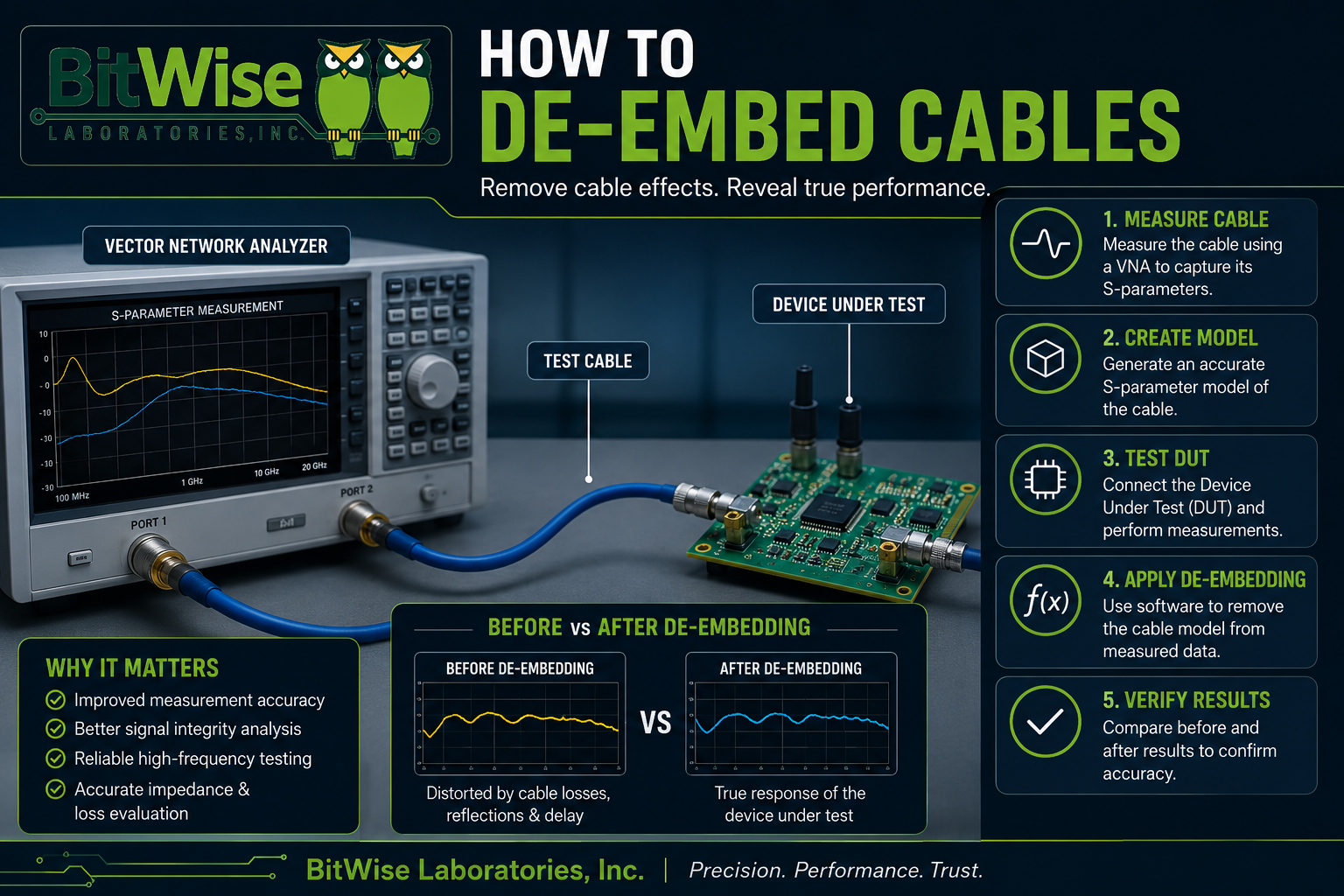
Step-by-Step Cable De-Embedding Process
Step 1: Measure the Cable
Begin by measuring the cable independently using a
calibrated test setup. Record the cable's electrical characteristics across the
required frequency range.
Step 2: Create a Cable Model
Generate an S-parameter model that accurately represents the
cable's behavior. This model serves as the basis for de-embedding calculations.
Step 3: Test the Device Under Test
Connect the DUT through the same cable and perform the
desired measurements.
Step 4: Apply De-Embedding
Use software tools to subtract the cable's influence from
the measured data. The resulting information represents the DUT's true
performance.
Step 5: Verify Results
Compare measurements before and after de-embedding to ensure
the correction process is working properly.
Best Practices for Accurate De-Embedding
To achieve reliable results, engineers should follow several
best practices:
- Use
high-quality, well-characterized cables.
- Perform
regular calibration of test equipment.
- Minimize
connector wear and damage.
- Maintain
consistent environmental conditions.
- Validate
de-embedding models using known reference devices.
Following these guidelines helps ensure that measurement
data remains trustworthy and repeatable.
Applications of Cable De-Embedding
Cable de-embedding is widely used in many engineering
fields:
High-Speed PCB Testing
Engineers use de-embedding to analyze PCB traces without
cable-induced distortions.
RF and Microwave Design
Accurate S-parameter measurements are critical for RF
components operating at high frequencies.
Signal Integrity Analysis
De-embedding helps identify true signal degradation within
electronic systems.
Semiconductor Validation
Chip manufacturers rely on de-embedding to evaluate device
performance accurately during development and production testing.
Conclusion
Understanding how to de-embed cables is a critical skill for
engineers involved in high-speed and high-frequency testing. By removing
cable-related effects from measurement data, engineers can obtain more accurate
insights into device performance and make better design decisions. Whether
working on PCB validation, RF testing, or signal integrity analysis, proper
de-embedding techniques can significantly improve measurement quality. BitWise
Laboratories supports advanced testing and analysis solutions that help
organizations achieve reliable and precise electronic measurements.
FAQ
What is cable de-embedding?
Cable de-embedding is a mathematical process used to remove
the electrical effects of cables from measurement results.
Why is de-embedding important?
It improves measurement accuracy by isolating the actual
performance of the device under test.
Which instruments are commonly used for de-embedding?
Vector Network Analyzers (VNAs), oscilloscopes, and signal
integrity analysis tools are commonly used.
Can de-embedding improve signal integrity measurements?
Yes, it helps eliminate cable-induced distortions, providing
more accurate signal integrity data.
Does every test setup require de-embedding?
Not always. However, it becomes increasingly important in
high-frequency and high-speed electronic applications.


Comments
Post a Comment