TDR Testing for PCB Traces: Advanced Signal Integrity Solutions for High-Reliability Electronics

In modern electronics manufacturing, ensuring signal
integrity across printed circuit boards (PCBs) is critical for performance,
reliability, and long-term durability. One of the most effective diagnostic
methods used in this field is TDR testing for PCB traces, which helps engineers
detect impedance mismatches, discontinuities, and faults in high-speed signal
paths.
BitWise Laboratories specializes in advanced testing and
validation services that support PCB designers and manufacturers in achieving
optimal circuit performance.
What is TDR Testing?
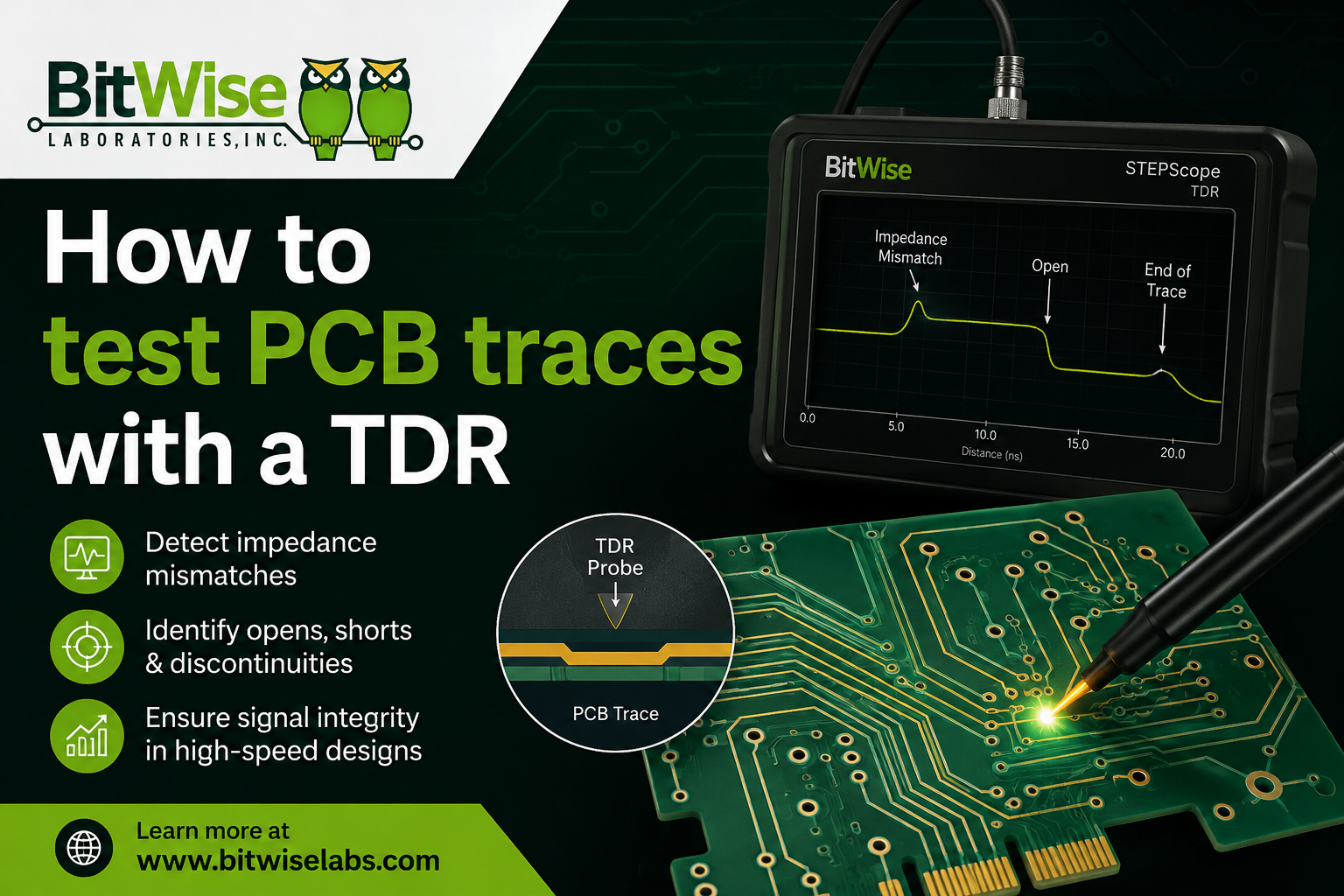
Time Domain Reflectometry (TDR) is a high-precision
measurement technique used to analyze signal reflections along transmission
lines. When a fast electrical pulse is sent through a PCB trace, any change in
impedance—such as a defect, via, or discontinuity—causes a portion of the
signal to reflect back.
By measuring these reflections, engineers can:
- Identify
open or short circuits
- Detect
impedance mismatches
- Locate
faults along PCB traces
- Analyze
signal integrity issues in high-speed designs
This makes TDR a critical tool in modern PCB validation
workflows.
Importance of Signal Integrity in PCB Design
As electronic devices become faster and more compact,
maintaining clean signal transmission becomes increasingly difficult. Even
minor inconsistencies in PCB traces can lead to:
- Data
transmission errors
- Reduced
device performance
- Increased
electromagnetic interference (EMI)
- System
instability in high-speed applications
This is where precise diagnostic methods like TDR testing for PCB traces
become essential for ensuring that every signal path performs as intended under
real operating conditions.
How TDR Testing Works in PCB Analysis
The TDR process involves sending a fast-rise-time pulse into
a PCB trace and observing the reflected waveform. The reflection pattern
provides a visual map of impedance variations along the trace.
Key steps include:
- Pulse
generation into the PCB trace
- Signal
reflection measurement
- Waveform
analysis
- Fault
localization and impedance profiling
This allows engineers to pinpoint exactly where a defect or
mismatch occurs, reducing debugging time significantly.
Applications of TDR Testing in Electronics
TDR is widely used across various industries, including:
- High-speed
digital circuit design
- Telecommunications
hardware
- Aerospace
and defense electronics
- Automotive
control systems
- Semiconductor
testing
In each of these fields, signal integrity is crucial, and
TDR helps ensure that PCBs meet strict performance standards.
Why Choose BitWise Laboratories for PCB Testing
BitWise Laboratories provides advanced testing
infrastructure and expert analysis for PCB validation and signal integrity
assurance. Their expertise in high-frequency measurement systems makes them a
trusted partner for engineers working on complex electronic designs.
Their services focus on:
- Accurate
impedance profiling
- High-speed
signal analysis
- Fault
detection in multilayer PCBs
- Engineering
support for design optimization
With state-of-the-art equipment and deep technical
expertise, they help manufacturers reduce design risks and improve product
reliability.
Benefits of TDR-Based PCB Analysis
Using TDR for PCB evaluation offers several key advantages:
- Non-destructive
testing method
- High
precision fault detection
- Real-time
signal behavior analysis
- Reduced
debugging and development time
- Improved
overall product reliability
These benefits make it an essential technique in modern PCB
manufacturing and quality assurance.
Practical Workflow in PCB Testing
In a professional lab environment, the TDR testing process
typically follows a structured workflow:
- PCB
preparation and calibration
- Baseline
impedance measurement
- Signal
injection and waveform capture
- Data
interpretation and fault mapping
- Reporting
and corrective recommendations
This systematic approach ensures accurate diagnostics and
actionable insights for engineers.
Conclusion
As electronic systems continue to evolve toward higher
speeds and greater complexity, precise diagnostic tools are more important than
ever. TDR testing for PCB traces provides engineers with the ability to detect
and correct signal integrity issues early in the design cycle, ensuring
reliable performance in critical applications.
With the expertise of BitWise Laboratories,
manufacturers gain access to advanced PCB analysis solutions that help deliver
robust, high-performance electronic products for today’s demanding industries.
FAQ: TDR Testing for PCB Traces
1. What does TDR testing measure in PCB traces?
TDR measures impedance variations and signal reflections
along PCB traces to detect faults and discontinuities.
2. Why is TDR important in high-speed PCB design?
It ensures signal integrity by identifying issues that can
affect data transmission and circuit performance.
3. Can TDR detect all types of PCB defects?
TDR is highly effective for electrical faults like opens,
shorts, and impedance mismatches, but may be combined with other tests for full
diagnostics.
4. Is TDR testing destructive?
No, it is a completely non-destructive testing method.
5. Where is TDR most commonly used?
It is widely used in telecommunications, automotive
electronics, aerospace systems, and high-speed computing hardware.
For more visit us: https://bitwiselabs.com/products/stepscope/


Comments
Post a Comment