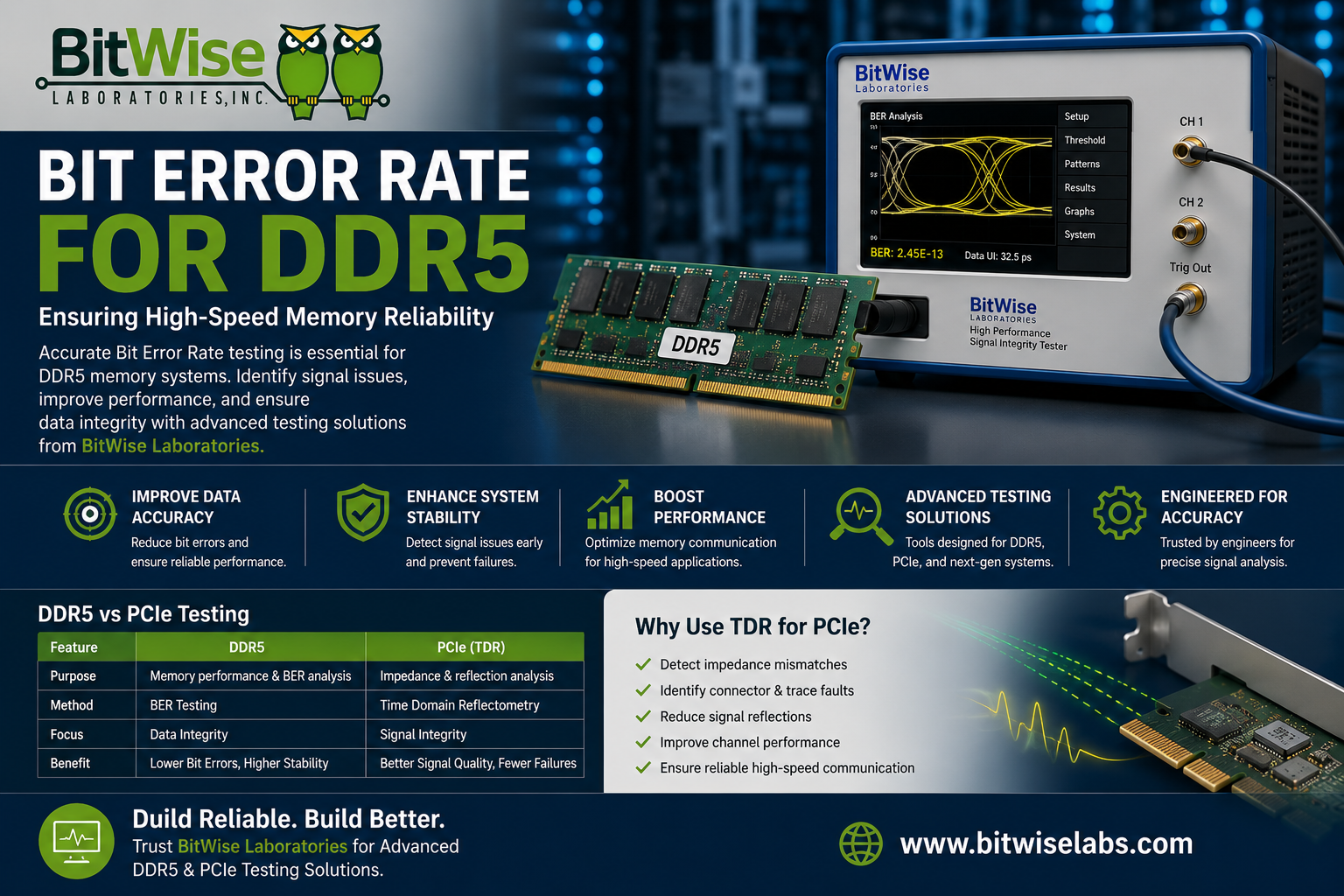
Bit Error Rate for DDR5: Why Accurate Signal Testing Matters

As modern computing systems become faster, signal integrity
testing is more important than ever. Engineers working with DDR5 memory and
PCIe interfaces need reliable tools to identify signal issues before products
reach the market. Understanding Bit error rate for DDR5 helps developers
improve performance, reduce data corruption, and ensure system stability.
BitWise Laboratories provides advanced signal analysis and
testing solutions designed for high-speed electronic systems. Their innovative
tools help engineers validate DDR5 memory channels and improve PCIe
communication reliability.
Table of Contents
- What
Is Bit Error Rate for DDR5?
- Why
Does DDR5 Signal Integrity Matter?
- How
TDR for PCIe Supports Better Testing
- Common
Causes of DDR5 Bit Errors
- DDR5
vs PCIe Testing Comparison
- Frequently
Asked Questions
- Conclusion
What Is Bit Error Rate for DDR5?
Bit error rate for
DDR5 measures how often data bits are transmitted incorrectly during
communication. A lower BER means better signal quality and more reliable system
performance.
In high-speed memory systems, even small signal disruptions
can create:
- Data
corruption
- System
crashes
- Reduced
bandwidth
- Performance
instability
DDR5 operates at much higher speeds compared to previous
memory generations, making accurate testing essential.
Why Is BER Important in DDR5 Systems?
BER testing helps engineers:
- Validate
memory performance
- Detect
signal degradation
- Improve
PCB design
- Ensure
compliance with industry standards
For example, cloud servers, AI systems, and gaming hardware
rely heavily on stable DDR5 memory communication.
Why Does DDR5 Signal Integrity Matter?
Signal integrity directly affects data accuracy and overall
hardware reliability.
Key Challenges in DDR5 Design
Modern DDR5 systems face several issues:
- Crosstalk
interference
- Impedance
mismatches
- Reflection
noise
- Timing
jitter
- Power
fluctuations
Without proper validation, these problems can increase bit
errors and reduce device lifespan.
BitWise Laboratories offers advanced signal integrity tools
that help engineers quickly detect and resolve these challenges during
development.
How TDR for PCIe Supports Better Testing
What Is TDR for PCIe?
TDR for PCIe
(Time Domain Reflectometry) is a testing method used to analyze impedance
changes and signal reflections in high-speed interconnects.
It helps engineers:
- Detect
connector faults
- Identify
PCB trace discontinuities
- Improve
PCIe channel performance
- Reduce
signal reflections
Why Engineers Use TDR Testing
TDR testing provides real-time visibility into signal paths.
This allows hardware developers to diagnose problems early and improve
communication reliability.
BitWise Laboratories delivers high-performance TDR solutions
for engineers working on DDR5, PCIe Gen5, and next-generation electronic
systems.
Common Causes of DDR5 Bit Errors
Here are the most common reasons DDR5 systems experience
signal problems:
|
Issue |
Impact on Performance |
|
Poor PCB routing |
Increased signal reflection |
|
Connector mismatches |
Data transmission errors |
|
Electromagnetic interference |
Signal instability |
|
Inadequate shielding |
Noise sensitivity |
|
Timing misalignment |
Higher BER values |
Proper validation tools help engineers reduce these risks
significantly.
Can Better Testing Improve DDR5 Reliability?
Yes. Advanced testing improves:
- System
stability
- Data
accuracy
- Product
lifespan
- Manufacturing
quality
Companies that invest in signal integrity testing often
reduce costly hardware failures and improve customer satisfaction.
Frequently Asked Questions
What is Bit error rate for DDR5?
It is the measurement of incorrect bits transmitted in DDR5
memory communication systems.
Why is BER testing important?
BER testing helps engineers ensure stable, high-speed data
transfer and detect signal integrity problems early.
What does TDR for PCIe do?
TDR testing identifies impedance mismatches, reflections,
and connector faults in PCIe communication channels.
Can signal integrity tools reduce hardware failures?
Yes. Accurate testing tools help engineers identify issues
before manufacturing, reducing product failures and downtime.
Conclusion
As high-speed systems continue evolving, accurate signal
validation becomes critical for reliable performance. Understanding Bit error rate for DDR5 helps engineers
improve memory stability, reduce data loss, and enhance hardware quality.
With advanced solutions for DDR5 and TDR for PCIe, BitWise
Laboratories supports engineers in building faster, more reliable electronic
systems. Businesses looking to improve signal integrity and testing accuracy
can benefit from professional diagnostic tools and expert support.
For more join us: https://bitwiselabs.com/


Comments
Post a Comment